Category Archives: Uncategorized

Getting Gassed in the U.S.

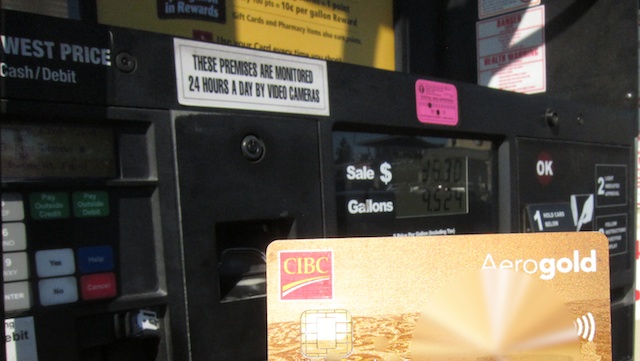
This credit card is not quite good as gold if you're a Canadian buying gas in the U.S.

This credit card is not quite good as gold if you’re a Canadian buying gas in the U.S.

Here’s a great trick I learn on the last day of a month-long road trip in the western U.S. Typically when buying gas in the States with a credit card, these days, I’m asked to enter a zip code. Since we Canadians don’t have those, I’m forced to walk inside and provide my credit card to the attendant, who checks the card and maybe my driver’s licence and asks me how much gas I want to buy before opening the pump. This sometimes involves going outside and hitting “Cancel” once or twice. Pain in the ass. Especially when I’m forced to guess how much gas I’ll need and, if I overestimate, have the extra amount credited back to my card, or at least so I’m told.

But when I’m buying gas at a Safeway in Spokane, Washington, a worker filling the windshield washing containers hears me whining and provides the tip that saves me the trip inside. Simply enter just the numbers from my Canadian postal code, followed by two 0s. Thus if my postal code is T5J 4E2, I enter 54200. Presto, I’m in business.

I’m not sure if this works in all states and at all gas stations, but I’ll certainly give it a try next time I’m stateside. Meanwhile, if any of you have tried this elsewhere, let me know.

Speaking of American gas stations, you’re not allowed to pump your own gas in Oregon. New Jersey, too, I believe. Something to do with safety regulations in those states. I do notice, however, that this gas-jockey service doesn’t extend to washing windshields.

The Best Toast Ever? In Revestoke, B.C., of All Places

Mind-blowingly good "healthy bread" toast at La Baguette in Revelstoke, B.C.

Mind-blowingly good “healthy bread” toast at La Baguette in Revelstoke, B.C.

Passing through Revelstoke, I stop once again at La Baguette, my favourite bakery/cafe between Calgary and Vancouver. Heck, its breads may be better than anything I’ve found in those two cities. This time, I order the Healthy Bread, a sandwich of toasted, round bread with melted cream cheese or three-berry jam in the middle. No ordinary toast, this is a magical blend of kamut flour, flax, coconut and dates—wonderfully soft in the middle and slightly crunchy from the oat-flake topping. It’s mind-blowingly good, and at $3.50 a steal of a light breakfast deal. Who needs eggs and bacon?

Of course, I blow my savings on a $9 loaf of gluten-free bread, a gift for a g-f friend. The server attributes the premium to the high cost of the ingredients. But weighing in at three pounds, it’s still pretty good cost-per-weight value. And it’s no doorstop, but instead a surprisingly moist, chewy loaf, quite wonderful toasted, as my friend can attest after wolfing down three slices.

This gluten-free bread, from La Baguette in Revelstoke, is almost wonderfully dense enough to bend my wrist.

This gluten-free bread, from La Baguette in Revelstoke, is almost wonderfully dense enough to bend my wrist.

All this healthy baking is almost enough to get me on the g-f bandwagon. Nah. We just need more of the world’s bakers to follow La Baguette’s lead. My bar for lowly toast has just been substantially raised.

La Baguette
607 Victoria Road, Revelstoke, B.C.
Daily 6:30 am-7 pm

Instant Backcountry Meals: Heresy or Simple Efficiency?

Boil, stir and serve: Instant backcountry dinner

Boil, stir and serve: Instant backcountry dinner

Over many years of backpacking and other mountain adventures, I’ve participated in a lot of group dinners where you take turns preparing supper. And these meals can get quite elaborate, to the point where you feel obliged to live up to the delicious organic chicken penne with homemade ragu sauce the person made the night before. Which means spending a lot of time preparing and dehydrating the meal at home, then rehydrating it in camp, stirring endlessly to keep things from burning to bottom of the stainless steel pot and timing everything to be hot at once.

There's no beating this homemade chile. But it's a lot of work, with two stoves going in camp

There’s no beating this homemade chile. But it’s a lot of work, with two stoves going in camp

But as I get older and wiser (lazier?), I’m increasingly tempted to go quick and easy. And if that means not living up to the competition, so be it.

So, you can spend your winters preparing and dehydrating meals for the summer’s backpacks and canoe trips or the spring’s ski traverses. Or you can let someone else do the work for you.

The secret is going instant, i.e. pouring boiling water over various ingredients, maybe simmering a bit and letting sit for a few minutes. Voila! Dinner in five minutes.

I know “instant” is heresy in some backcountry circles, perhaps stemming from the days of cup-of-soups and quick ramens laced with artificial ingredients and MSG. But now, with a wee bit of searching and ingenuity, you can concoct quick meals that are both healthy and quite tasty. And it’s a lot cheaper than buying packaged backcountry meals.

The other day, for example, I prepared a quick black bean dish based mainly on ingredients from my local health food store. I took a cup each of instant black beans and instant, organic brown rice flakes, added a handful of freeze-dried peas and a teaspoon of red chile powder for zip. In camp, I poured all this into about three cups of boiling water in a non-stick aluminum pot, stirred in a package of coconut milk power, let sit for a few minutes and served with grated parmesan cheese. The result was a flavourful meal for two hungry hikers, three with smaller appetites.

By contrast, here's my instant black bean supper ingredients, ready to be boiled and served

By contrast, here’s my instant black bean supper ingredients, ready to be boiled and served

Sure, the consistency kind of resembled porridge. But the good thing about working up a hearty appetite in the great outdoors is everything tastes a little better than at home. And if it saves me many hours of labour, I say sign me up.

And the hungry customer isn't complaining... at least not to my face

And this hungry customer isn’t complaining… at least not to my face

Sorry, We’re Closed. We Just Didn’t Bother to Tell Anyone

Sorry, we're not open, and you couldn't find this out till you arrived at our front door

Sorry, we’re not open, and you couldn’t find this out till you arrived at our front door

On a recent Thursday in August, I struck out on three central Alberta restaurants. It wasn’t a series of bad experiences. I just couldn’t get in the locked front doors.

It started with a considerable drive to a north Edmonton breakfast café. But the anticipated pancakes were not to be, since a sign on the door said they were closed for August holidays.

No big deal. I just went to plan B in downtown Edmonton, where after plugging $2 into a meter, I was greeted with a “closed for a four-day break” sign. Rather famished on the drive back to Calgary, I stopped at a Red Deer-area diner. Strike three.

Now, I have no problem with restaurants taking some time off. It’s a tough business, and owners and staff deserve a break, especially in summer when the weather’s nice and kids are on school vacation. Plus, the places I haunt are independently owned and thus free to maintain the schedules they want.

My issue is communicating these closures with prospective customers. To be fair, the first place I ventured to had a notice on its website, in red letters, that it would be closed for a specified period. My bad for not checking.

The other two spots, though, had nothing other than the “closed” sign on the door. One had no web presence whatsoever, the other a Facebook page that hadn’t been updated in months (believe me, both practices are surprisingly common throughout North America). Maybe the regulars were informed of these closures. But anyone, who like me, had heard of these places through Yelp or Urbanspoon and perhaps driven a fair distance to dine there, was s**t out of luck. And let me tell you, there’s nothing worse than a hungry diner scorned.

Now, it’s up to restaurant owners to decide if they want to spend the time and money to take advantage of the considerable advertising power that a website offers. But a Facebook or Twitter account is free and can be set up, and updated, in minutes. So to me, it’s a terrible discourtesy to both regular and potential customers to not take the few minutes—less time, indeed, than to cook a couple of eggs—to let them know you’re not going to be open. Because once burned, I’m not likely to give these places a second chance.

Your thoughts?

Thoughts From a Long Road Trip

Image

Getting high in the U.S. southwest

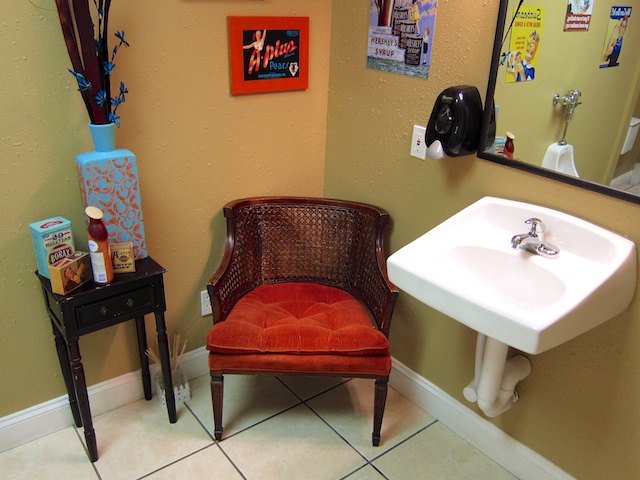
Why do many restaurants with upwards of 100 seats often have only two, single-occupant bathrooms, one for men and one for women (and sometimes just one single-sex toilet? Especially places that serve coffee or beer.

Have you ever seen a brewery or winery that wasn’t award winning?

At a Phoenix-area motel, a customer asks where the ice machine is. “It takes a quarter,” the desk clerk says, explaining that otherwise guys would fill up coolers. “It takes a quarter.” Better, don’t you think, than “it costs a quarter.” For some reason, this reminds me of a friend who said of his apparel, “I take a medium, but a large fits me better.”

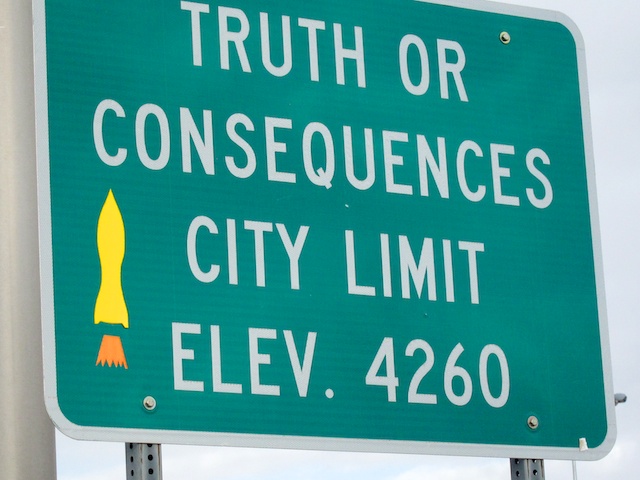
I’ve noticed that a lot of towns and small cities on this trip have entrance signs that give a) their elevation and b) their founding year. What’s interesting is how high some of these towns are, starting at 4,000 feet and going way up from there. This low end is higher than just about any place in Canada.

Driving south of Tucson, I’m surprised to see some freeway distance signs listed in kilometres, not miles. Maybe they’re getting people ready for Mexico.

A coffee roaster neatly sums up my new and improved strategy for testing as many road food places as possible in a minimum amount of time: Eating a little a lot. Eating less means ordering two a la carte tacos, so I can easily chow down on a Sonoran hot dog an hour later. That means staying away from the Mexican “plates” and their carbo- and calorie-heavy rice and refried beans. Don’t think I’ve had Mexican rice yet on this trip. Can’t say I miss it. There should be a prize for any chef who comes up with an interesting take on this bland, tired grain.

I’m typing away on my iPad in a coffee shop while drinking a big pot of French press coffee. “You’re wired,” a woman says. Yes and yes.

Image

Scene from a road road trip where you bite off more than you can chew. A guy wanders up to me at a Phoenix gas station, asking for a buck. “No, but I’ve got half an excellent pizza you can have,” I say, reaching for the takeout box. He skedaddles.

In Prescott, Arizona, three young guys with packs, long dreadlocked hair and a dog (with its chin on the ground) are holding up a cardboard sign: Traveling, Broke and Ugly. Worth a couple of bucks.

Traffic circles, or roundabouts, can be a very efficient method of keeping traffic moving. But the long string of them in and around Sedona, AZ seems fairly new, judging by the vehicles stopping in the middle when they have the right of way. The design here could also use some improvement. The islands are too big and the corners too tight, witness the black rubber smeared all over the curbs.

Image

Other than a couple of Americanos at Tucson roasters Cafe Aqui and EXO, the best mugs of coffee I’ve had on this three-week road trip have been those I’ve made myself, from EXO beans. Can’t beat the 1/3 cup of grounds I use for one drip cup.